I Built a 16-Agent AI Team That Runs My Company. Here's What I Learned.

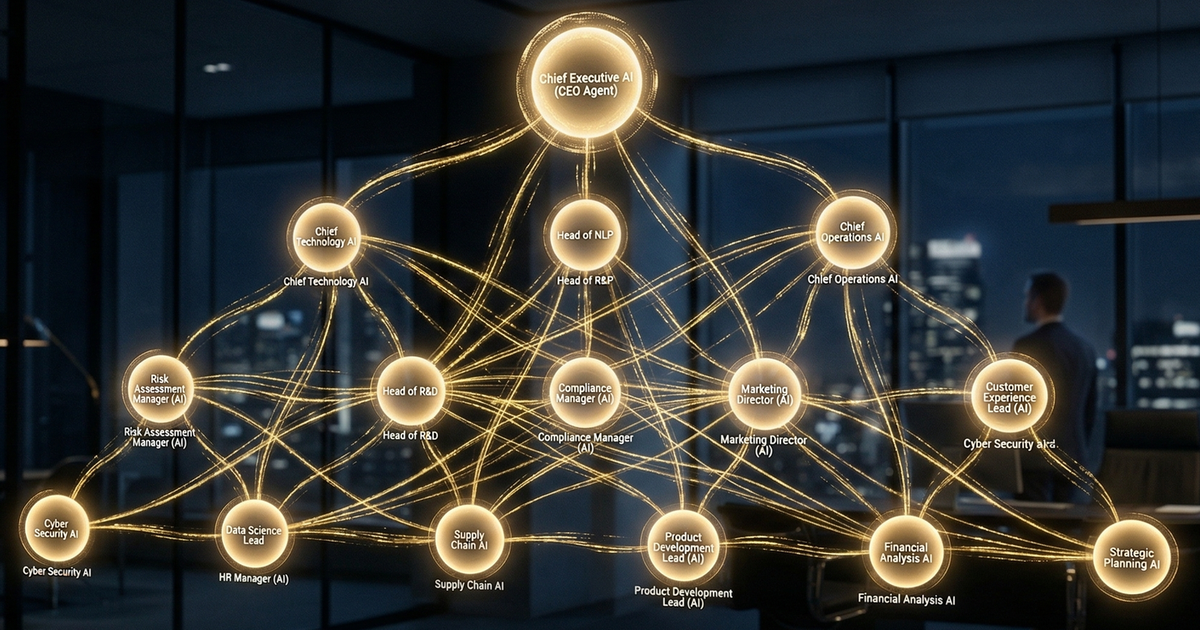
Over the past few months, I've implemented artificial intelligence into the operational management of my company.
Not a chatbot that answers questions. Not a copilot that completes sentences. Sixteen autonomous AI agents — each with a defined role, a defined scope of authority, and the ability to communicate with and task each other.
One manages community and communications. One handles business development and pipeline. One runs investor relations and fund communications. One does market intelligence and data research. One manages operations and scheduling. One is a legal counsel agent that reviews contracts and compliance communications before they go out.
They have access to email. They draft documents. They coordinate across time zones. They flag issues before I see them. They hand tasks to each other based on role.
Here's what I learned after six months of actually running a company this way.
Why I Did This
I run AfCEN — Africa's AI-powered infrastructure intelligence platform. We sit at the intersection of development finance, climate, infrastructure, and critical minerals across the continent. The operational complexity is real: multiple active deals, multiple investor conversations, regulatory environments across 54 countries, a distributed team across Africa and Europe.
I was spending 60-70% of my time on coordination, communication, and information management. Not thinking. Not building relationships. Not making the decisions only I can make. Coordination.
The question I kept asking was: what if I could buy that back?
Traditional automation wasn't the answer. It's rigid, rule-based, and breaks the moment something falls outside the expected pattern. AfCEN as a neuro network where every project, every government, every deal all contribute to and benefit from the ecosystem needed dynamic coordination. What I therefore needed was systems that could handle ambiguity — that could read context, apply judgment within defined parameters, and escalate the things that genuinely required human decision-making.
Large language models, structured correctly, can do that. The key word is "structured."
The Architecture: Roles, Not Tools
The first mistake most people make when deploying AI agents is treating them like tools. A tool executes a command. An agent holds a role.
The difference is not semantic. It changes everything about how you design the system.
A tool that drafts emails is triggered when you need an email. An agent that owns communications makes decisions about when to draft, what tone to use, what to flag for your attention, what to handle autonomously, and what crosses a line that requires human judgment. It operates within a defined scope even when you're not watching.
I designed sixteen agents across four functional clusters:
Revenue and Commercial — business development, partnerships, investor relations, market intelligence. These agents manage the top of my commercial funnel, track opportunities, and surface deals I should be paying attention to.
Operations and Finance — scheduling, administration, financial tracking, legal compliance. These agents keep the machine running. They handle the 40% of operational tasks that are deterministic and shouldn't require my attention.
Knowledge and Intelligence — data research, competitive intelligence, content strategy, ecosystem monitoring. Africa's infrastructure landscape moves fast. These agents surface what I need to know before I know I need to know it.
Communications — community management, content production, brand voice, crisis monitoring. Everything that shapes how AfCEN shows up publicly — social, newsletter, stakeholder communications — runs through this cluster.
Each agent has a name, a defined role, a hierarchy (who it reports to, who its peers are, what it can do autonomously vs. what requires escalation), and access to the specific tools its role requires. Nothing more.
The Hierarchy Matters More Than the Agents
The breakthrough insight — the thing that made this actually work — was that the organizational structure matters more than any individual agent's capability.
I spent weeks designing the hierarchy before I deployed a single agent. Who reports to whom. What decisions each level can make. When does something escalate. How do agents hand off to each other.
This mirrors how real organizations work, because it has to. Flat structures fail at scale — in human organizations and in AI agent systems. Without clear reporting lines and escalation protocols, agents either over-escalate (constantly asking for human input on things they should handle) or under-escalate (handling things that genuinely require human judgment without flagging them).
Getting this wrong is expensive. Getting it right creates a system that actually amplifies your judgment rather than requiring constant supervision.
The structure I landed on has a CEO agent (MANSA) at the top of the AI hierarchy. Not as a replacement for me — I remain the human principal. But MANSA filters, coordinates, and routes. I talk to MANSA. MANSA coordinates the team. I am not in every conversation.
What Surprised Me
Speed. The most immediate impact wasn't quality — it was velocity. Tasks that used to queue for days because they required me to get to them moved in hours. A draft that needed to exist before a conversation could happen existed before I opened my laptop.
Memory. Human teams have inconsistent institutional memory. People forget context. They're not in every conversation. They hold information in their heads and it doesn't transfer. AI agents with structured memory files are consistent in a way human teams aren't. Every agent knows the relevant context of every past decision because it's written down and accessible.
Escalation calibration. This took months to tune. Initially, agents escalated too much — treating every non-standard situation as requiring my input. The correction was making escalation criteria more explicit in the agent design. Now the system surfaces the right things. That calibration work never fully ends.
The boundary problem. Agents don't always know what they don't know. An agent confident in its domain will sometimes act on incomplete information rather than flagging uncertainty. Building in explicit uncertainty signals — requiring agents to mark confidence levels on outputs, to flag gaps in their knowledge — reduced this significantly. But it required intentional design.
Human team integration. This was the most complex part. My human team members work alongside the agents. That relationship requires explicit design — who owns what, how does work transfer, when does a human step in. The agents that work best are the ones where my human team members are clear on the handoff protocol and trust the agent's output within its scope.
What Doesn't Work
AI agents are not good at tasks that require genuine novelty — situations outside the scope of their design where judgment needs to emerge from first principles. They can reason within their context. They can't transcend it.
They are not good at building relationships in the full sense. They can manage relationship logistics — scheduling, follow-up, information sharing. The relationship itself requires human presence.
They are not good at detecting when a situation has fundamentally changed in a way that makes their existing instructions obsolete. This is a category of escalation failure that's hard to engineer around. You solve it partly through regular review of agent instructions and partly through building in explicit environment-monitoring triggers.
Cost is real. Sixteen agents running continuously, with tool access, processing documents, calling APIs — it adds up. I manage this through tiered activity levels: some agents are always-on, some are triggered by specific events, some run on a cadence. If you deploy this without attention to cost architecture, you will be surprised.
What I'd Tell Anyone Starting
Start with one agent that handles one thing you hate doing. Not sixteen. One. Build it properly — real instructions, real scope, real escalation logic — and run it for a month. You will learn more from that than from reading every article about autonomous AI.
Design the hierarchy before you design the agents. Know what your organization looks like, who owns what, how decisions get made. Then build agents that map to that reality. Don't build agents and try to figure out the org structure afterward.
Treat memory as infrastructure. The agents that are most useful are the ones that maintain accurate, up-to-date context files. Memory isn't a feature — it's the difference between an agent that's useful on day one and useless by day thirty, versus one that compounds in value.
Build in human checkpoints, especially early. The instinct is to automate away review. Resist it. At L3 autonomy (agents operating independently within defined scope, consulting humans on judgment calls), the system is genuinely valuable. At L5 (full autonomy), it's genuinely risky unless you've earned confidence in every scenario it will face. Most deployments should stay at L3 for the first six months.
The Honest Assessment
A few months in: I have genuinely bought back a significant portion of my time. The coordination overhead that was eating 60-70% of my operational bandwidth is now running without my constant attention.
What I do more of now: the decisions that only I can make. The relationships that require my judgment and trust. The strategic thinking about where AfCEN should go and why.
What the agents do: everything that can be specified clearly enough to delegate.
That boundary — what can be specified versus what requires human judgment — is the central question of how to deploy AI in an organization. It's not a philosophical question. It's a practical one you answer through iteration.
The system is not finished. It will never be finished. Every week reveals something that needs adjustment, a scope that needs tightening, an escalation that happened when it shouldn't have or didn't happen when it should.
But the direction is clear. This is how I'll run the company. Not because it's the future — because it's already working.
Joseph Ng'ang'a is the founder and CEO of AfCEN, Africa's infrastructure intelligence platform. AfCEN delivers AI-powered data across energy, agriculture, critical minerals, and infrastructure to project developers, investors, and policymakers across the continent.
Follow for more on building AI-first organizations, African infrastructure finance, and the intersection of data sovereignty and development.